


The grocery run for the graduation party ends at the kitchen island with a half sheet cake, a deli platter, and two gallons of milk waiting for somewhere to go. The cake will not lie flat on any shelf because a divider runs down the middle. The platter goes in at an angle, tips, and gets set on the counter instead. Milk ends up wedged sideways in a door bin because the shelf spacing was set for something else, and the container of leftover chili from Tuesday has already disappeared behind a wall of condiments. That daily game of refrigerator geometry is exactly the problem a french door refrigerator was designed to solve, and it is why the layout now outsells every other style in American kitchens.
Find a Refrigerator That Fits Your Kitchen and Your Groceries
Appliance Center has been helping northwest Ohio and southeast Michigan families choose appliances since 1953, with showroom floors full of working models you can open, measure, and compare. Our own delivery teams handle installation, water line hookup, and haul-away of the old unit.
The reassuring part is that choosing well comes down to a short list of decisions, most of which you can settle with a tape measure and an honest look at how your household eats. At Appliance Center, our appliance specialists walk Toledo area shoppers through those decisions every day, from Old West End kitchens with original doorways to new builds in Perrysburg and Sylvania. This guide covers how a french door refrigerator is configured, how to measure so delivery day goes smoothly, counter depth versus standard depth, capacity and interior layout, which features earn their price, a comparison table, the honest trade-offs, and the models on our floor right now.
Key Takeaways
- The layout follows how people actually cook: Fresh food sits at eye level in a full-width compartment because most households reach for refrigerated items far more often than frozen ones.
- Measuring is the step that fails deliveries: The cabinet opening matters, but the doorway, hallway turn, and stair landing between the truck and the kitchen are what most often stop a delivery cold.
- Counter depth trades capacity for looks and walkway space: A counter depth model sits nearly flush with cabinets and typically gives up meaningful cubic feet compared with a standard depth unit of the same width.
- Interior layout matters more than the cubic feet number: Shelf configuration, drawer flexibility, and door bin sizing determine whether the capacity you paid for is usable.
What Is a French Door Refrigerator and Why Is It So Popular?

A french door refrigerator is a refrigerator with two side-by-side doors that open onto a single full-width fresh food compartment at eye level, with one or more freezer drawers underneath. Opening both doors gives you an unbroken shelf that runs the entire width of the cabinet, with no center divider in the way.
The design logic is simple household math. Most families open the fresh food side several times for every trip into the freezer, so the fresh food compartment sits at the most convenient height and the freezer goes below where bending is less frequent. That single decision is why the style took over from the traditional side-by-side layout in most kitchens.
The Configurations You Will See
- Three-door models: Two refrigerator doors above a single pull-out freezer drawer. The most common configuration and usually the best value at any given capacity.
- Four-door models: Two refrigerator doors, a middle flex drawer, and a bottom freezer drawer. The middle drawer often converts between refrigerator and freezer temperatures.
- Five-door layouts: Two refrigerator doors above dual bottom drawers, sometimes with independently controlled zones for entertaining or bulk storage.
There is a practical benefit that gets overlooked in tight kitchens. Two narrow doors swing out roughly half as far as one wide door does, which matters enormously in a galley kitchen or when the refrigerator sits near an island. A 36 inch single door needs a full 36 inches of swing clearance in front of it. Two 18 inch doors need far less.
The full-width shelf changes storage behavior in ways that are easy to underestimate until you live with it. A half sheet pan lies flat. A party platter goes in without being tilted. Pizza boxes, sheet cakes, roasting pans, and the turkey on Thanksgiving all fit horizontally instead of being balanced across two levels. Supporting features work with that layout, including adjustable spill-proof shelves that contain a spill rather than letting it run down through everything, humidity-controlled crispers that hold greens and produce at different moisture levels, dual evaporator systems that keep freezer air separate from fresh food air, and inverter compressors that run at variable speed instead of cycling hard on and off.
Read More: 7 Frigidaire Refrigerator Features Homeowners Love | How to Choose the Best Home Appliances for Your Kitchen in 2026
Sizing and Measuring for a French Door Refrigerator

Width classes are the starting point. Most french door models come in 30, 33, and 36 inch widths, with 36 inches by far the most common. Widths beyond that exist in built-in and column configurations, which are a different category with different installation requirements.
Three measurements decide whether the refrigerator fits the space:
- Cabinet opening width: Measure at several heights, since walls and cabinet faces are rarely perfectly plumb, and use the narrowest number.
- Height including hinge clearance: Measure to the underside of any upper cabinet, and remember the top hinge needs room to swing when the doors open.
- Depth including doors and handles: The refrigerator’s depth specification often excludes handles, and handles project two inches or more.
Door swing clearance is the measurement people forget. French doors do not need much space to open enough for daily use, but they need to swing well past ninety degrees for crisper drawers and shelves to come out for cleaning. A refrigerator boxed in by a perpendicular wall or a tall pantry on one side may open fine and still make shelf removal impossible.
The Pre-Measure Checklist
Complete this before you shop, and bring the numbers with you:
- Cutout width: At the narrowest point of the opening.
- Height: From the floor to the underside of the cabinet above.
- Depth: From the back wall to the front edge of the counter.
- Door swing clearance: On both sides, noting any wall or island in the way.
- Full delivery path: Including front door width, hallway turns, and stair landings.
- Water line location: And whether a shutoff valve is present.
- Electrical outlet location: Behind the refrigerator space.
The delivery path is the single most common reason a delivery fails, and it has nothing to do with the kitchen. Measure the narrowest point between the truck and the final position, which is usually a front door, a tight hallway corner, or a basement stair turn. Here is the habit our delivery crews use and recommend: compare that narrowest opening against the refrigerator’s depth with the doors removed rather than its full width, because most french door units go through doorways sideways with the doors off, and that number is often three to four inches smaller than the spec sheet width. If the narrowest point is within an inch of that figure, tell us before delivery day so the crew arrives prepared.
Ventilation clearance is the quiet one. Manufacturers specify space at the top, sides, and rear so heat can escape, and a cabinet cutout built exactly to the refrigerator’s dimensions can trap that heat, which makes the compressor work harder and run longer. Finally, confirm water line access and outlet placement for any model with an ice maker or dispenser, since running a new line after the refrigerator is in place is a plumbing job rather than an adjustment.
Counter Depth Versus Standard Depth French Door Refrigerators
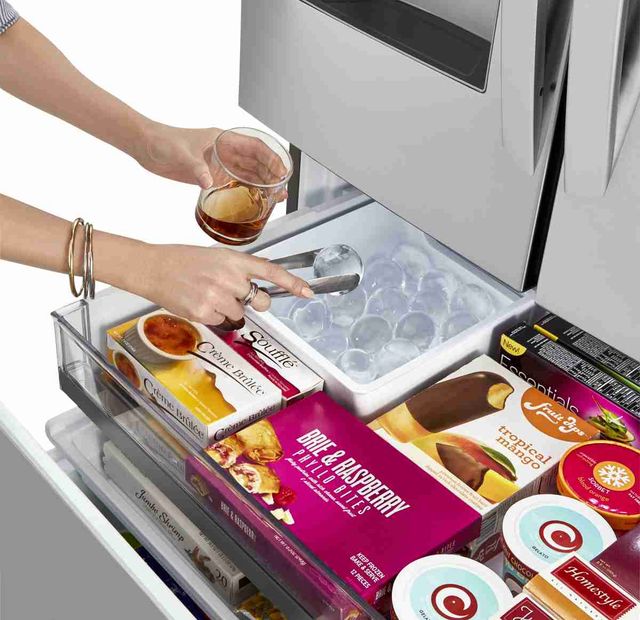
A counter depth french door refrigerator is built to sit nearly flush with standard base cabinets, typically projecting only as far as the doors and handles. A standard depth model runs several inches deeper and visibly projects past the cabinet run.
The trade-off is direct and worth stating plainly: counter depth models give up meaningful capacity. A 36 inch standard depth unit commonly holds somewhere in the mid to high twenties in cubic feet, while a counter depth unit of the same width usually lands in the low to mid twenties. You are paying similar money for less storage in exchange for the built-in look and the walkway space.
Who each suits:
- Counter depth: Open-concept kitchens where the refrigerator is visible from the living area, galley kitchens and tight walkways, island kitchens where a projecting door blocks traffic, and anyone who wants a built-in appearance without built-in pricing.
- Standard depth: Large households, bulk shoppers, families who cook in volume, and kitchens with enough room that a few extra inches of projection go unnoticed.
Manufacturers have blurred the line with counter-depth-plus and cabinet-depth models that split the difference, and the marketing labels are not consistent between brands. Measure the actual published depth specification rather than trusting the description on the tag, because one brand’s counter depth is another brand’s standard.
Depth also changes how the interior works. A shallower cabinet means shorter shelves, and items are far less likely to get lost behind other items. Plenty of counter depth owners report that they waste less food, simply because nothing survives forgotten at the back.
The honest way to weigh it: look at your current refrigerator right now. If it is routinely packed to capacity and you shop in bulk, the lost cubic feet will hurt. If it is half full most weeks and you shop twice a week, you are buying storage you do not use and giving up walkway space to store it.
Capacity, Interior Layout, and Organization
Cubic feet ratings describe total interior volume, split between the fresh food compartment and the freezer. Advertised capacity is measured with the shelves and drawers removed, so usable capacity is always less, and models with in-door ice makers, thick shelving, or elaborate drawer systems lose more of it than simple ones.
General capacity guidance by household, treated as a range rather than a rule:
- One or two people: Roughly 18 to 22 cubic feet is plenty unless you cook in large batches.
- Three or four people: Roughly 22 to 26 cubic feet handles a typical weekly shop with room for leftovers.
- Five or more, or bulk shoppers: Roughly 26 cubic feet and up, especially if a warehouse club run happens monthly.
Interior features determine whether that space is usable day to day:
- Adjustable and split shelving: Half-width shelves let a tall pitcher or a stockpot stand upright without sacrificing an entire level.
- Spill-containment edges: Raised shelf edges keep a tipped container from running down through three shelves.
- Humidity-controlled crispers: Separate settings for greens that want moisture and fruit that does not.
- Deli and snack drawers: A shallow full-width drawer keeps lunch meat and cheese from disappearing behind milk jugs.
- Gallon door bins: Confirm the bins actually hold a gallon jug, since not every model’s do.
- Full-width temperature-controlled drawers: Useful for beverages, party trays, and thawing.
The middle flex drawer on four-door models deserves its own consideration. Convertible temperature settings let it run as extra refrigerator space during the holidays and as freezer space the rest of the year, which is genuinely useful for households whose storage needs swing seasonally. It also adds cost and one more sealed compartment to service.
Freezer drawers organize better than swing doors in one specific way: sliding baskets and dividers let you see what is on top rather than reaching into a dark cavity. The trade-off is that items in the bottom layer of a deep drawer still get forgotten, and bulky boxed items sometimes fit a swing-door freezer better. Interior lighting quality matters more than it sounds, since a well-lit interior with tempered glass shelves shows you what is there, while wire shelving on a dim interior hides things.
The most useful shopping habit here is auditing what you actually store. If your kitchen runs on tall bottles, shop door bin height. If it runs on platters and sheet pans, shop full-width shelf clearance. If it runs on frozen bulk goods, shop freezer configuration rather than total cubic feet.
Features Worth Paying For and Features You Can Skip
Ice and Water
External dispensers put ice and cold water at the door, which is the most-used feature in many households, but the ice maker and chute occupy door space that would otherwise hold gallon bins. In-door ice makers free interior shelf space at the same cost. Interior ice makers keep the door line clean and full of storage but require opening the refrigerator to get ice. Dual ice makers add a second unit in the freezer for high-volume households, and craft or specialty ice makers produce slow-melting clear cubes that matter to some people and to nobody else. Any of these requires a water line to the refrigerator, so factor plumbing into the decision if none exists.
Cooling Technology
Dual evaporator systems give the refrigerator and freezer separate cooling circuits, which keeps freezer odors and dry freezer air out of the fresh food compartment and helps produce last longer. Air filtration reduces odor transfer within the compartment. Inverter compressors run at variable speed rather than switching fully on and off, which holds temperature more steadily, uses less energy, and runs noticeably quieter in an open kitchen where the refrigerator is a few feet from the sofa.
Smart and Connectivity
The candid read: door-open alerts and remote temperature monitoring are genuinely useful, especially if you travel or if a door gets left ajar by kids. Interior cameras and large touchscreens are enjoyable and rarely change how anyone shops or cooks after the first month. Buy connectivity if you will use the alerts, not because the display looks impressive on the showroom floor.
Finishes and Design
Fingerprint-resistant stainless has become the practical default in homes with children, and it makes a real difference on a door that gets touched twenty times a day. Black stainless and matte finishes suit specific design directions but are harder to match later if another appliance is replaced. Panel-ready models accept custom cabinet fronts for a fully integrated look at a significant premium. Flat doors read more contemporary, contoured doors read more traditional, and handle style is more visible than most shoppers expect. Confirm door swing direction and any reversibility limits before purchase.
Efficiency
An ENERGY STAR certified refrigerator uses meaningfully less electricity than the federal minimum, and the yellow EnergyGuide label gives an estimated annual operating cost you can compare directly between models. Refrigerators run continuously for a decade or more, so a modest annual difference compounds into real money across the life of the appliance.
The framework that cuts through all of it: features that change how you use the refrigerator every single day are worth paying for, and features that mostly change the spec sheet are not. Shelf flexibility, ice configuration, and door bin sizing are daily. A touchscreen is not.
Read More: Best Dishwasher Brands for Reliable Cleaning | How to Choose Between a Front Door vs Top Door Washing Machine
Maintenance, Longevity, and Getting the Most From Your Refrigerator
Routine maintenance is short and it decides how long the appliance lasts:
- Water filter: Replace roughly every six months, or sooner if flow slows or ice production drops.
- Air filter: Where equipped, replace about every six months to keep odors down.
- Condenser coils: Vacuum them once or twice a year, more often in homes with pets, since dust-blanketed coils force the compressor to run longer and hotter.
- Door gaskets: Wipe them clean and check the seal by closing a dollar bill in the door and pulling. Real resistance means the seal is good.
Set the fresh food compartment near 37 degrees and the freezer near 0 degrees, then leave them alone. How you load matters too, because airflow needs a path. Blocking the vents at the back of the compartment with a wall of containers creates warm spots regardless of the setting.
Ice makers cause more service calls than any other component. Clumping usually means the ice has partially melted and refrozen, which points to a door left ajar or a freezer running too warm. Slow production usually points to low water pressure or a filter overdue for replacement.
Leveling matters more on a french door refrigerator than on any other style, because two doors have to close evenly against a center seal. A cabinet that is even slightly out of level lets one door hang low, which prevents the seal from closing and causes condensation, frost, and higher energy use. Door alignment is adjustable on most models and is part of a proper installation.
On warranty: most manufacturers cover the sealed system, meaning the compressor, condenser, and related components, for longer than they cover everything else. Register the appliance at purchase so that coverage is on file when you need it, and keep the receipt.
Call for service rather than troubleshooting further when you see inconsistent temperatures between compartments, water pooling under the crisper drawers, frost building on the freezer walls, or a compressor that runs continuously without cycling. Those symptoms point to sealed system or defrost issues rather than a setting.
French Door Refrigerator Configurations Compared Side by Side
The table below compares the layouts you will actually be choosing between, with a traditional side-by-side included as a reference point since many shoppers are replacing one. Read across the row that matches your kitchen constraint rather than your capacity wish.
| Configuration | Typical Width | Typical Capacity | Projection Past Cabinets | Best-Fit Household | Main Limitation |
|---|---|---|---|---|---|
| Standard depth three-door | 33 to 36 in. | Mid twenties to low thirties | Several inches | Large families and bulk shoppers | Sticks out past cabinets |
| Counter depth three-door | 33 to 36 in. | Low to mid twenties | Nearly flush | Open kitchens and tight walkways | Less capacity for the price |
| Four-door with flex drawer | 36 in. | Mid twenties to low thirties | Varies by model | Seasonal or shifting storage needs | Higher price, more components |
| Counter depth four-door | 36 in. | Low to mid twenties | Nearly flush | Design-driven kitchens wanting flexibility | Premium tier pricing |
| Traditional side-by-side | 33 to 36 in. | Low twenties to high twenties | Several inches | Households needing lots of freezer access | Narrow doors, no full-width shelf |
For most kitchens the answer is a 36 inch three-door model, and the real decision is depth. Choose counter depth when the refrigerator is visible from a living space or the walkway is tight, and standard depth when capacity is the priority and a few inches of projection go unnoticed.
French Door Refrigerator Pros and Cons Every Buyer Should Weigh
Against a top freezer, a bottom freezer, or a side-by-side, a french door refrigerator wins on daily convenience and loses on simplicity and price. It puts the food you reach for most at the height you reach most easily, and it asks you to bend for frozen goods and pay more for the privilege. That is a fair trade for most households and a poor one for a few, so here is the honest accounting.
Pros
Fresh food at eye level
The compartment you open most sits at the most comfortable height.
Full-width shelving
Sheet pans, platters, and pizza boxes lie flat instead of being wedged or stacked.
Narrow door swing
Two half-width doors need far less clearance than one wide door in a galley kitchen.
Flexible storage zones
Split shelves, convertible drawers, and humidity-controlled crispers adapt to what you store.
The widest feature selection
Nearly every current cooling, ice, finish, and connectivity option is offered in this format.
Cons
Bending for the freezer
Frozen items sit low, which is a real consideration for anyone with knee or back limitations.
Higher price than comparable layouts
A french door model costs more than a top freezer or bottom freezer unit of similar capacity.
More components to service
Feature-rich models add ice makers, dispensers, and convertible zones, and every added system is one more thing that can need attention.
What Northwest Ohio Kitchens and Water Do to a Refrigerator
Two things about this area change refrigerator ownership in ways a national buying guide will never mention, and the first is the housing. Toledo’s older neighborhoods, from the Old West End to Point Place and the East Side, are full of homes built before 36 inch refrigerators existed, with kitchen doorways under 30 inches, tight back-hall turns, and basement stairs that were never meant for appliance delivery. Mid-century ranches in Sylvania, Maumee, and Oregon commonly have a 33 inch cutout with cabinets built tight around it, which quietly rules out a large share of today’s 36 inch lineup. The second is the water: household supply across the Toledo area runs on the harder side, and hard water is exactly what shortens the life of an ice maker and a water filter, leaving mineral scale in the fill tube and the mold that shows up first as slow, cloudy, or clumping ice.
Practical adjustments for homes here:
- Measure the doorway and stair turns before you fall in love with a 36 inch model, because in older Toledo homes that is the constraint far more often than the kitchen cutout is.
- Plan on changing the water filter closer to every four to six months than the twelve some households stretch to, since harder water loads a filter faster.
- Watch for slow ice production as the first symptom of scale rather than a failing ice maker, and check filter age before you call anyone.
- Think twice about a second refrigerator in an unheated garage unless it is rated for low ambient temperatures, because an Ohio winter can drop a garage below the range a standard refrigerator’s thermostat is designed for, and the freezer compartment can actually thaw.
- Account for summer humidity off Lake Erie, which can produce condensation on door seals in a warm kitchen and makes proper leveling and a clean gasket more important here than in a dry climate.
- If the kitchen is on a slab-floor addition or a settled older floor, expect to spend real time on leveling, since two doors closing against a center seal are unforgiving of an out-of-level cabinet.
Top French Door Refrigerators Available at Appliance Center
The selections below span standard and counter depth, capacities from roughly 21 to nearly 29 cubic feet, and a range of budgets, so there should be a fit whether you are filling a large family kitchen or squaring off a flush profile in an open floor plan.
GE Profile™ ENERGY STAR® 36” 28.7 Cu. Ft. Fingerprint Resistant Stainless Steel French Door Refrigerator with Dual-Dispense AutoFill Pitcher

Shop French Door Refrigerators
For the household that fills a refrigerator every week, this is the capacity answer in this lineup at 28.7 cubic feet in a 36 inch standard depth cabinet. The Dual-Dispense AutoFill Pitcher is the standout, filling itself with filtered water so there is always cold water ready without anyone standing at a dispenser. ENERGY STAR certification means the operating cost stays reasonable despite the size, and the fingerprint resistant stainless finish holds up in a kitchen where the door gets touched constantly. It suits large families, bulk shoppers, and anyone who entertains.
Top Features
- 28.7 cubic feet of capacity: The largest in this group, sized for a full weekly shop plus holiday overflow.
- Dual-Dispense AutoFill Pitcher: A pitcher that fills itself with filtered water, so cold water is always ready.
- ENERGY STAR certified: Lower estimated annual operating cost across a decade of continuous running.
- Fingerprint resistant stainless steel: Stays presentable in a busy kitchen without constant wiping.
GE® 36” 27 Cu. Ft. Fingerprint Resistant Stainless Steel French Door Refrigerator

Shop French Door Refrigerators
This is the mainstream family choice, and for a lot of Toledo area kitchens it is the right one. Twenty-seven cubic feet in a 36 inch standard depth cabinet covers a household of four or five without stepping into premium pricing, and the fingerprint resistant stainless finish handles daily traffic. Everything here is aimed at practicality rather than novelty, which is what most shoppers actually want once the showroom excitement passes. Choose this one if you have the depth to spare and want maximum usable space per dollar.
Top Features
- 27 cubic feet of capacity: Ample room for a family weekly shop with space left for leftovers.
- 36 inch standard depth cabinet: Maximum interior volume for the width, at the cost of projecting past cabinets.
- Fingerprint resistant stainless steel: Practical finish for a high-traffic kitchen.
- Straightforward feature set: Focused on storage and reliability rather than screens.
LG 29.7 Cu. Ft. PrintProof™ Stainless Steel French Door Refrigerator

Shop French Door Refrigerators
When storage is the whole point, this LG brings 29.7 cubic feet, the most in this entire showcase. That is genuine bulk-shopper territory, the kind of capacity that swallows a warehouse club run without anything being left on the counter. The PrintProof stainless finish resists smudges and wipes clean, which matters on a door this large. It is a standard depth model, so plan on it projecting past the cabinet run, and confirm your delivery path before ordering, since the largest cabinets are the ones that test older doorways.
Top Features
- 29.7 cubic feet: The largest capacity offered here, built for bulk shopping and big households.
- PrintProof stainless steel: Resists fingerprints and smudges on a large, frequently touched door surface.
- Full-width fresh food compartment: Wide platters, sheet pans, and party trays lie flat.
- Standard depth format: Maximum interior volume, best suited to kitchens with room to spare.
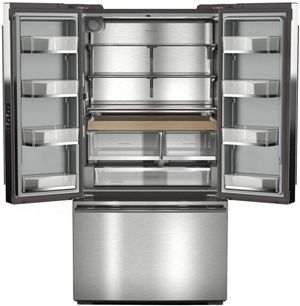
KitchenAid® 36” 24.3 Cu. Ft. PrintShield™ Stainless Steel Counter Depth French Door Refrigerator with Interior Dispense
Shop Counter Depth Refrigerators
Counter depth usually means giving up capacity, and 24.3 cubic feet is an unusually generous number for a flush-fitting 36 inch cabinet. That makes this the pick for an open-concept kitchen that still needs to feed a full household. Interior dispense keeps water and ice inside the compartment, which leaves the door face clean and uninterrupted and preserves door bin space for gallon jugs. The PrintShield finish resists fingerprints on a refrigerator that is visible from the living room, which is exactly the scenario counter depth exists to serve.
Top Features
- 24.3 cubic feet in a counter depth cabinet: Generous capacity without projecting past the cabinet run.
- Interior dispense: Water and ice inside the compartment, keeping the door face clean and the bins usable.
- PrintShield stainless steel finish: Built to stay clean where the refrigerator is on display.
- Flush profile: Clean sightlines in an open floor plan and more usable walkway.
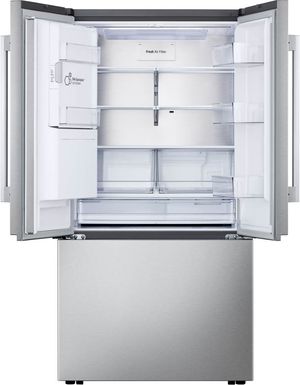
LG 36” 23.7 Cu. Ft. PrintProof™ Stainless Steel Counter Depth MAX™ with Zero Clearance™ French Door Refrigerator
Shop Counter Depth Refrigerators
Zero Clearance is the feature to understand here, because it addresses the exact problem the measuring section described. The doors are designed to open fully without needing extra room beside the cabinet, which means crisper drawers and shelves come out for cleaning even when the refrigerator sits tight against a wall or a tall pantry. Combined with Counter Depth MAX construction that recovers interior volume, 23.7 cubic feet in a flush-fitting cabinet is a strong result. This is the answer for a tight galley or a refrigerator boxed in on one side.
Top Features
- Zero Clearance door design: Doors open fully without extra side clearance, so drawers still come out for cleaning.
- Counter Depth MAX construction: Recovers interior volume that counter depth cabinets normally give up.
- 23.7 cubic feet: Real family capacity in a flush-fitting footprint.
- PrintProof stainless steel: Smudge-resistant finish for a refrigerator on display in an open kitchen.
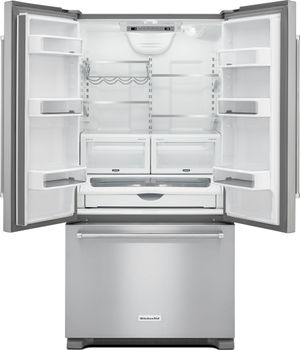
KitchenAid® 36 in. 21.9 Cu. Ft. Stainless Steel Counter Depth French Door Refrigerator
Shop Counter Depth Refrigerators
This is the accessible route into counter depth, and it fits the household that decided walkway space and a built-in look matter more than maximum cubic feet. At 21.9 cubic feet in a 36 inch flush-fitting cabinet, it comfortably covers a couple or a smaller family that shops weekly rather than monthly. KitchenAid’s construction and stainless finish bring a premium feel without premium pricing, and the shallower interior means fewer forgotten containers at the back. A strong choice for a condo, a townhouse, or a remodeled kitchen with a tight island clearance.
Top Features
- 21.9 cubic feet counter depth: Right-sized for couples and smaller households that shop weekly.
- Flush cabinet profile: Preserves walkway space in kitchens with an island or a narrow galley.
- Stainless steel finish: Familiar, easy-to-match appearance alongside existing appliances.
- Shallower interior: Less depth means fewer items lost behind other items.
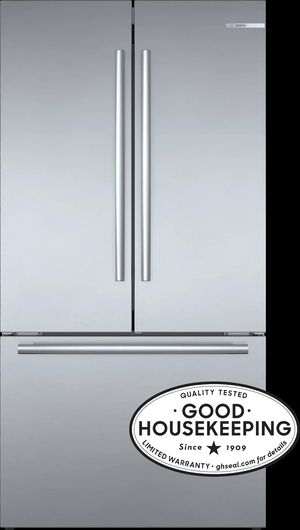
Bosch® 800 Series 36” 20.8 Cu. Ft. Stainless Steel Counter Depth French Door Refrigerator
Shop Counter Depth Refrigerators
Bosch’s 800 Series is the design-forward entry in this group, aimed at the kitchen where the refrigerator has to look as considered as the cabinetry. At 20.8 cubic feet in a 36 inch counter depth cabinet, it commits fully to the flush, integrated appearance rather than chasing capacity. Bosch is known for quiet operation, which is a genuine daily benefit in an open floor plan where the kitchen and the living room share a space. Choose this one if a clean, low-profile look and quiet running matter more to you than another few cubic feet.
Top Features
- 800 Series design tier: Bosch’s step-up line, built around a clean, integrated appearance.
- 20.8 cubic feet counter depth: Committed flush profile for design-driven kitchens.
- Quiet operation: A real advantage in open floor plans where the kitchen opens to living space.
- Stainless steel finish: Understated look that pairs well with contemporary cabinetry.
Finding the Right French Door Refrigerator for Your Kitchen
Measure carefully, including the delivery path and not just the kitchen cutout, settle the counter depth versus standard depth question based on how full your current refrigerator actually runs, and shop the interior configuration rather than the cubic feet number alone. Get those three right and the rest of the decision is finish, ice configuration, and budget.
Come see them in person at Appliance Center. Our showroom lets you open the doors, pull the drawers, and measure the shelf clearance against the platter you actually own, with staff who can compare models side by side and tell you honestly where the differences matter. Our own teams handle professional installation, water line hookup, and haul-away of the old unit, and local service is here after the sale rather than routed through a call center. That is what an independent northwest Ohio retailer offers instead of a box on a curb and a phone tree. Shop french door refrigerators online or stop by, and bring your measurements.
Frequently Asked Questions about French Door Refrigerator Options
Most kitchens are built around a 36 inch cutout, with 30 and 33 inch widths available for tighter spaces, and the right capacity generally runs about 18 to 22 cubic feet for one or two people, 22 to 26 for a family of three or four, and 26 or more for larger households and bulk shoppers. Measure the cabinet opening width, the height to the underside of the cabinet above, and the depth from the wall before shopping, since the opening dictates your options more than capacity preference does.
Counter depth is better when the refrigerator is visible from a living area, the walkway is tight, or an island limits clearance, because it sits nearly flush with the cabinets. Standard depth is better when capacity matters most, since a counter depth model of the same width typically holds several cubic feet less, and the practical test is whether your current refrigerator actually runs full each week.
Each door needs enough room to swing past ninety degrees so crisper drawers and shelves can be removed, which usually means a few inches of clear space beside the cabinet on the hinge side. Some models are engineered with zero clearance door designs that open fully against an adjacent wall, and those are worth seeking out in galley kitchens or when the refrigerator sits beside a tall pantry.
A three-door model has two refrigerator doors above a single freezer drawer, while a four-door model adds a middle drawer between them that often converts between refrigerator and freezer temperatures. The four-door layout gives you flexible storage that adapts to holidays and seasonal shopping, at a higher price and with one more temperature-controlled compartment in the system.
A well-maintained french door refrigerator commonly lasts about ten to fifteen years, with the sealed system usually outliving the ice maker, dispenser, and electronic controls. Cleaning the condenser coils once or twice a year, changing the water filter on schedule, and keeping the unit properly leveled so both doors seal against the center strip are the three habits that most affect how long it runs well.
Operating cost depends far more on capacity, ENERGY STAR certification, and compressor technology than on door style, and an ENERGY STAR certified french door model with an inverter compressor often costs less to run than an older side-by-side. Compare the estimated annual operating cost on the yellow EnergyGuide label between the specific models you are considering, since that number reflects the actual configuration rather than the category.
Why Trust Appliance Center?
Appliance Center is a trusted destination for quality home solutions, offering top appliances, mattresses, and furniture to help you upgrade every room in your home. Our commitment is simple: deliver reliable products, competitive pricing, and exceptional customer service.
Shop Furniture & Mattresses at Appliance Center
At Appliance Center, the customer always comes first. Our knowledgeable team is ready to help you find everything you need for your home with ease and confidence.